Art degraded, Imagination denied
War govern’d the Nations.
—“The Laocoön,” William Blake
Where there is sorrow there is holy ground.
—De Profundis, Oscar Wilde
In mundane astrology, planetary transits are associated with global politics and conditions. “Mundane” here means not boring, but worldly—the etymology is from the Latin mundi, for world.
The big news of 2026 on this front: Saturn and Neptune conjoining at 0o Aries on February 20. These two heavyweights hovered near a conjunction in Aries through 2025 that perfects just once this year. They won’t be exact again, but have been within the 15-degree orb suggested by the philosopher-astrologer Richard Tarnas for mundane transits for some time—since March 22, 2024—and will remain within it until late April 2027.
This conjunction takes place about every 36 years. In the 20th century, it coincided with the start of WWI (1917), the Cold War and McCarthyism (1952-53), and the fall of the Berlin Wall (1989) and subsequent dissolution of the Soviet Union in 1991. It tends to coincide with events that have long-term consequences and tremendous impact on the world.
Tarnas’ landmark Cosmos and Psyche doesn’t explore the Saturn-Neptune conjunction in quite as much depth as other alignments, but he does meditate on it to some degree in that work. He also has a paper on its appearance in natal charts, available here. (William Blake was born with a Saturn-Neptune opposition, while Oscar Wilde was born with the square, he notes, quoting the lines from both that open this post above.)
I’m just gonna say it, folks: this conjunction is not fun. In fact, it could be hard-core depressing AF. On some levels, as we’re already seeing in relation to the protests and federally initiated violence in Minnesota, it could be gut-wrenching, even horrifying.
I’ll explore its potential positive expressions below, but first let’s review the obvious parallels between now and previous eras. Here’s Tarnas in his usual elegant terms:
There is … a tendency during Saturn-Neptune eras to experience a subtle but pervasive darkening of the collective consciousness, sometimes as a diffuse and difficult-to-diagnose social malaise, at other times as a direct response to deeply discouraging or tragic events. Reflecting the complex in its most intense form, such eras are frequently marked by collective experiences of tragic loss, the defeat of ideals and aspirations, the death of a dream, which are accompanied by a sense of profound sorrow. (470)
Tarnas cites as an example the 2004 election, in which George W. Bush was elected to a second term. A Saturn-Neptune opposition had just come into 15-degree orb that November:
The pervading sense that an ideal had been lost took many forms—the loss of an ideal image of what the United States had once represented both to its citizens and to the world, the defeat of widespread hopes for a change in the world’s leadership at a critical time in history, the sense of futility felt after so much work on behalf of that cause, the loss of faith in the democratic process, lingering doubts about the truthfulness of the vote count and the legitimacy of the election. Highly characteristic of the Saturn-Neptune complex was the pervasive experience of discouragement and depression, resignation, pessimism, despair, and dazed disorientation that descended on many in the following weeks and months like an immense dark cloud. (470)
The parallels between the 2004 election—not to mention the 2000 election and Bush v. Gore—and the first and second Trump administrations are clear. Since this conjunction entered 15-degree orb last year, the United States has rapidly become, not a beacon of democracy and civil rights, but a global bully.
In the summer of 2005, with the Saturn-Neptune opposition closer in orb, Hurricane Katrina descended upon New Orleans. Tarnas’ description of that period also feels evocative now. He points to
a widespread sense of diffuse helplessness, disillusionment and despair, bitter disappointment with the government’s massive failure and negligence, and private outpouring of compassion, prayer, sacrifice, and aid. … The focus of collective judgment and division in the aftermath of the 2005 crisis during the Saturn-Neptune period was on empathy and the failure of empathy. (471)
And if that wasn’t bad enough, here’s one more level of despair:
Frequently seen on the spiritual level during Saturn-Neptune eras are dark nights of the soul and severe challenges to religious faith, such as Nietzche’s announcement of the “death of God” during the Saturn-Neptune conjunction of 1881-82, or John Lennon’s song “God” in late 1970 (“God is a concept by which we measure our pain”), as well as his bitter postmortem for the 1960s during the same 1970-73 alignment: “The dream is over.” Often individuals during these periods question the existence of an all-loving God who would permit tragic events and vast human suffering. (472-3)
To sum up: in today’s climate—in a world of extreme distance between haves and have-nots, of cruelty, instability, regression to violent ideologies, paranoia, and fear—Saturn’s repressive tendencies may depress Neptunian idealism in a confrontation with “reality” that can be dispiriting if not heart-breaking.
Yet to some extent, we undoubtedly co-create reality, and many archetypes in astrology express in complex, Janus-faced forms. Witness Minneapolis citizens now transforming a siege by ICE (Saturn) into community, connection, and revived faith in democratic ideals, the human spirit, and collective ability to care for others and their welfare (Neptune).
As Tarnas also notes, Saturn-Neptune periods
tend to coincide with collective experiences of opposite sides of the same complex: loss of faith and disillusionment but also forging of a deeper faith in the face of harsh or tragic realities. … Here the synthesis of Saturn and Neptune is expressed through the strenuous effort to embody spiritual values and compassionate ideals by enacting them within the concrete realities and challenges of the human community. A call for service and sacrifice is strongly felt. The Dalai Lama, who was born with Saturn opposite Neptune, is a paradigmatic example of this potential example of the complex. Frequently, the experience or witnessing of suffering serves to dissolve rigid boundaries and past enmities, and to call forth unitive and compassionate healing impulses. (473)
There’s no spiritual bypassing here—with Saturn conjoining Neptune now, we can’t “manifest” our way out of homicidal policing, despotic regimes, environmental disaster. Yet the gravitas (Saturn) of this conjunction can lend itself to transcendent spiritual experiences, devotion, and determination (Neptune).
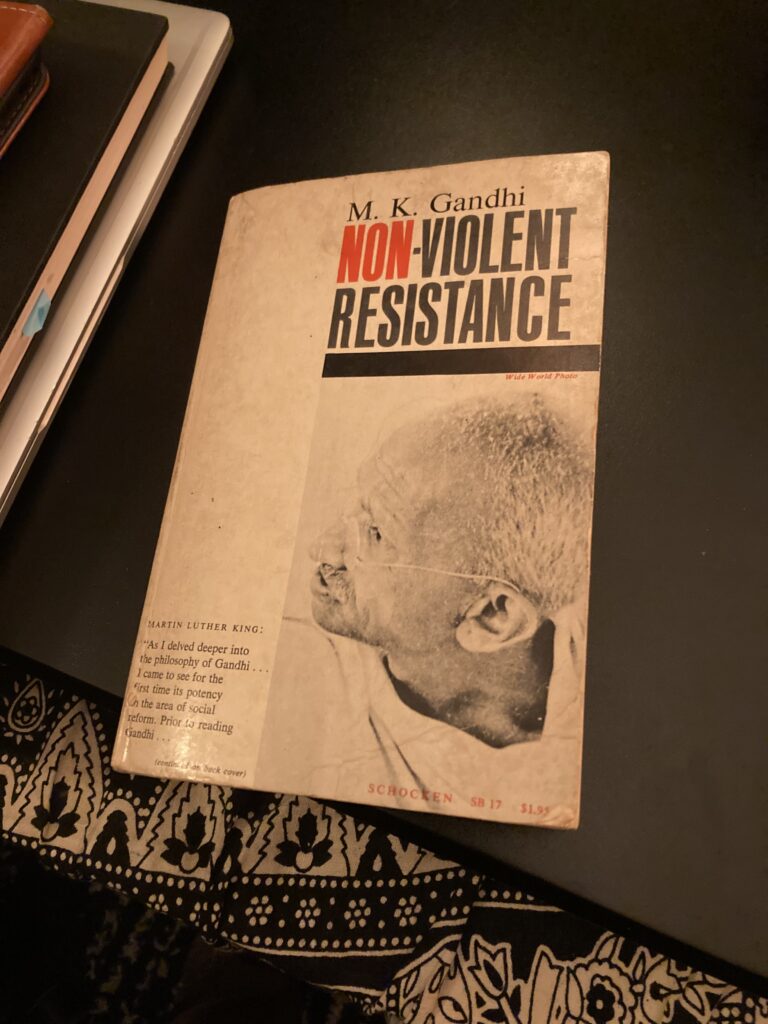
Naturally, then, nonviolence is also a theme during Saturn-Neptune periods. One example: Thoreau’s essay On Civil Disobedience, published in 1849, was prompted by his refusal to pay taxes during the 1846 conjunction to a federal government that supported slavery. That work famously inspired Gandhi and Martin Luther King Jr., both born with a Saturn-Neptune trine.
During the years surrounding this conjunction, we may see new clarity around how to collectively implement ideals as well as profound connection to the divine. And we can attempt to stay focused on the positive despite the relentless onslaught of horrifying news by actively creating it. We can refuse to participate in callousness and cruelty and seriously dedicate (Saturn) ourselves to creating a better world (Neptune)—one where everyone always matters and where dehumanization, callousness, and cruelty are permanent relics of history. Current attempts at inoculation to lawless violence don’t need to be integrated into our collective and individual psyches. We can actively work to create a different world, one where such things are no longer possible, even plausible.
What’s interesting about this period is that Neptune and Uranus are also in alignment—which is potentially substantially more positive. As one faction regresses, another may soldier on, finding creative solutions to the planetary crises we find ourselves mired in. Which side do you want to be on? The time to decide is now.
Tarnas describes periods of Neptune-Uranus contacts as
characterized … by … pervasive transformations of a culture’s underlying vision: widespread spiritual awakenings, the birth of new religious movements, cultural renaissances, the emergence of new philosophical perspectives, rebirths of idealism, sudden shifts in a culture’s cosmological and metaphysical vision, rapid collective changes in psychological understanding and interior sensibility, certain forms of scientific paradigm shifts, new utopian social visions and movements, and epochal shifts in a culture’s artistic imagination. (356)
Though it’s not all rosé all day. He continues:
More problematical, these alignments also tend to coincide with periods of widespread spiritual and philosophical confusion and disorientation that were associated with the rapid dissolution of previously established structures of belief and certainty, and a greater than usual susceptibility to mass entrancements of various kinds. As with other configurations of Uranus, there was consistently evident either an exciting, liberatory, awakening quality, accompanied by spontaneous creative innovation, or a disruptive, destabilizing quality produced by sudden, unexpected radical change. (356)
With the recent and current transits to the U.S. Sibly chart—which I’ll explore in another post before too long—significant destabilization isn’t out of the question during the rest of Trump’s (now interminable-seeming) term.
Importantly, too, intervention does not have to mean confrontation. Diffusing and de-escalating can be crucial—even life-saving. From transcripts of a talk given at The Metta Center for Nonviolence:
Tank Man, standing in front of a column of tanks all by himself, is a powerful image, but the really powerful human being is she or he who is deeply aware of her or his interconnectedness with other beings and can influence them on that very deep level.
What does that look like in practice? They continue:
You are acting out a deeply held belief among visionary nonviolent actors, like Mahatma Gandhi, that the positive reality, good, that you’re cooperating with is not only also there, along with the evil that you’re struggling against, but it is even, if I could use a kind of fancy term here from philosophy, it’s ontologically prior—it is the thing that really exists, and all the various forms of evil that we see all around us are really negative transformations of that positive consciousness, that positive energy.
More from the Metta Center here.
Keywords and themes for the Saturn-Neptune conjunction:
- Nonviolence (Gandhi’s satyagraha , or “clinging to truth”)
- Spiritual gravitas, spiritual sacrifice
- Transcendent ethics, universal spirituality
- Sensitivity to suffering and sorrow, in oneself and others
- “Somber realism” (a phrase from Tarnas)
- Disenchantment, disillusionment
- Breaking free of tradition, the dissolution of old structures
- Secret societies, paranoia (Astrology Podcast)
For more on the Saturn-Neptune conjunction, the Astrology Podcast’s 8-hour (!) historical exploration is thorough and fascinating.